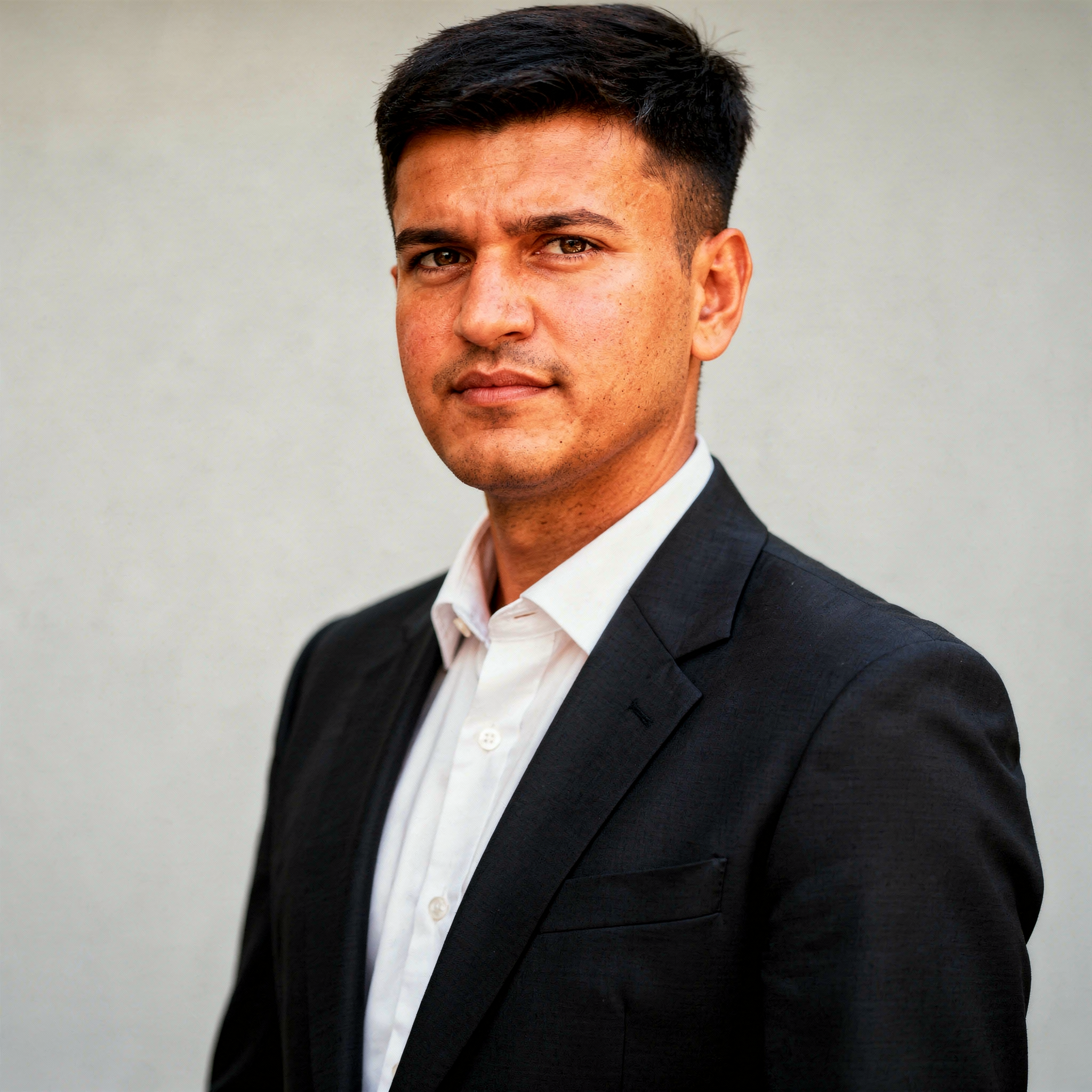
Aryan Garg
Generative Modeling and Computational Photography Researcher | ML/AI Engineer
I'm a 2nd year CS PhD student at the University of Wisconsin-Madison, advised by Professor Mohit Gupta.
I have been fortunate to work with many brilliant professors and experts throughout my journey. Prof. Renu Rameshan ignited my interest in computer vision early during my Bachelor's at IIT Mandi which also led me to exploring generative modeling for outdoor lighting during my junior year with Prof. Jean-François Lalonde and Dr. Yannick Hold-Geoffroy. After graduating, I spent a wonderful year at IIT Madras getting closer to sensors alongside developing 3D reconstruction and generative facial video editing methods as a Bosch Research Fellow at the Computational Imaging Lab directed by Prof. Kaushik Mitra. Interestingly, my vision sensors and generative interests got a human touch to them as I spent the summer of '24 at the Computational Behaviour Lab, advised by Prof. Antti Oulasvirta and now Professor, Yue Jiang.
Apart from research, I enjoy riding my motorcycle, cooking, playing Fortnite with my close friends Julian Fabinc and Franzi on the weekends. I also love classic game titles like RDR2 and MOBAs: AoE2, LoL, Rust.
My research interests lie at the intersection of generative modeling, computational imaging, and visual aesthetics. My research aim is a bidirectional one: capturing the richness of our visual world to preserve memories as we saw them is a core goal, and in turn, this goal acts as a grounding physical harness for generative models. Ultimately, I envision a future where generative image and video models behave less like black boxes and more like renderers of reality, offering precise, compositional control to further creativity through visual editing.
Recent News
- May 2026 Part of the first FLUX Creators cohort of Black Forest Labs
- Jun 2026 My CVPR '26 paper: gQIR was a Highlight Presentation!
- Mar 2025 Gave a talk at Sony, Japan: Generative Priors for ISPs
- Feb 2025 Won the CS department UW-Madison Fellowship Award for the summer of 25!
- Feb 2025 North America finalist for Qualcomm Innovation Fellowship, 2025.
- Aug 2024 Now at UW-Madison as a CS Master's & PhD student!
- May 2024 Interned at Aalto University, Finland at Professor Antti Oulasvirta's HCI lab.
- Aug 2023 Bosch Research Fellowship at IIT Madras.
- May 2022 MITACS Globalink Research Internship at Professor Jean Francois Lalonde's awesome lab in Quebec!
Featured Projects
gQIR: Generative Quanta Image Reconstruction
Adapting large-scale generative priors for photon-counting or SPAD-based neural ISPs to image under extreme motion.
HDRSplat: Gaussian Splatting for High Dynamic Range
High Dynamic Range 3D Gaussian Splatting from raw images. Achieves night-time HDR 3D reconstructions as well.
IP-FaceDiff: Identity-Preserving Facial Video Editing
Identity-preserving facial video editing with diffusion models.
Publications
gQIR: Generative Quanta Image Reconstruction
CVPR 2026 (Highlight; Top 10%)
Radiance Fields from Photons
ToG 2025 & SIGGRAPH 2026
Controllable GUI Exploration
Preprint, 2025
Diffusion for automatic GUI designing & ideation
IP-FaceDiff: Identity-Preserving Facial Video Editing with Diffusion
WACV-W, 2025
Identity-Preserving Facial Video Editing with Diffusion
HDRSplat: Gaussian Splatting for High Dynamic Range 3D Scene Reconstruction
BMVC, 2024
Stereo-Knowledge Distillation from dpMV to Dual Pixels for Light Field Video Reconstruction
ICCP, 2024
Parameter and Data Efficient Spectral Style DCGAN
ICLR Tiny Paper, 2024 (Oral Presentation)
Unconditional face generation at the speed and size of DCGAN using a relatively tiny training dataset (~4000).
G-PECNet: Towards a Generalizable Pedestrian Trajectory Prediction System
ICLR Tiny Paper, 2024 (Oral Presentation)
Synthetic dataset generation and sinusoidal activations lead to a winning solution over the final displacement error.
Academic Services
Reviewer For
- CVPR 2026
- ECCV 2026
- ICLR 2024, 2025, 2026
- CVPR-W: AI for Content Creation, AI4CC 2024
- ICVGIP 2023
Teaching Assistant
- CS639.1 - Data Management (UW-Madison, Fall '24)
- EE5719 - Deep Learning for Imaging (IIT Madras, Fall '23)
- CS208 - Mathematical Foundations (IIT Mandi, Fall '21)
- EE522 - Matrix Theory (IIT Mandi, Fall '21)